
Top Black Hair Color Shampoo Manufacturers in India: 2026 Sourcing Guide
Looking for a reliable black hair color shampoo manufacturer in India? Whether you are launching a beauty brand, importing hair coloring products or expanding a wholesale portfolio, selecting the right manufacturing partner can determine your product quality, regulatory readiness and long-term business success.
How do you choose a black hair color shampoo manufacturer in India? Evaluate the manufacturer’s production capabilities, formulation options, cosmetic quality systems, testing procedures, packaging flexibility, minimum order quantities and export documentation. Request samples, ingredient declarations, applicable manufacturing licences and batch-specific quality records. Hennahub India is one sourcing option for businesses exploring black hair color shampoo, bulk supply and brand-development enquiries.
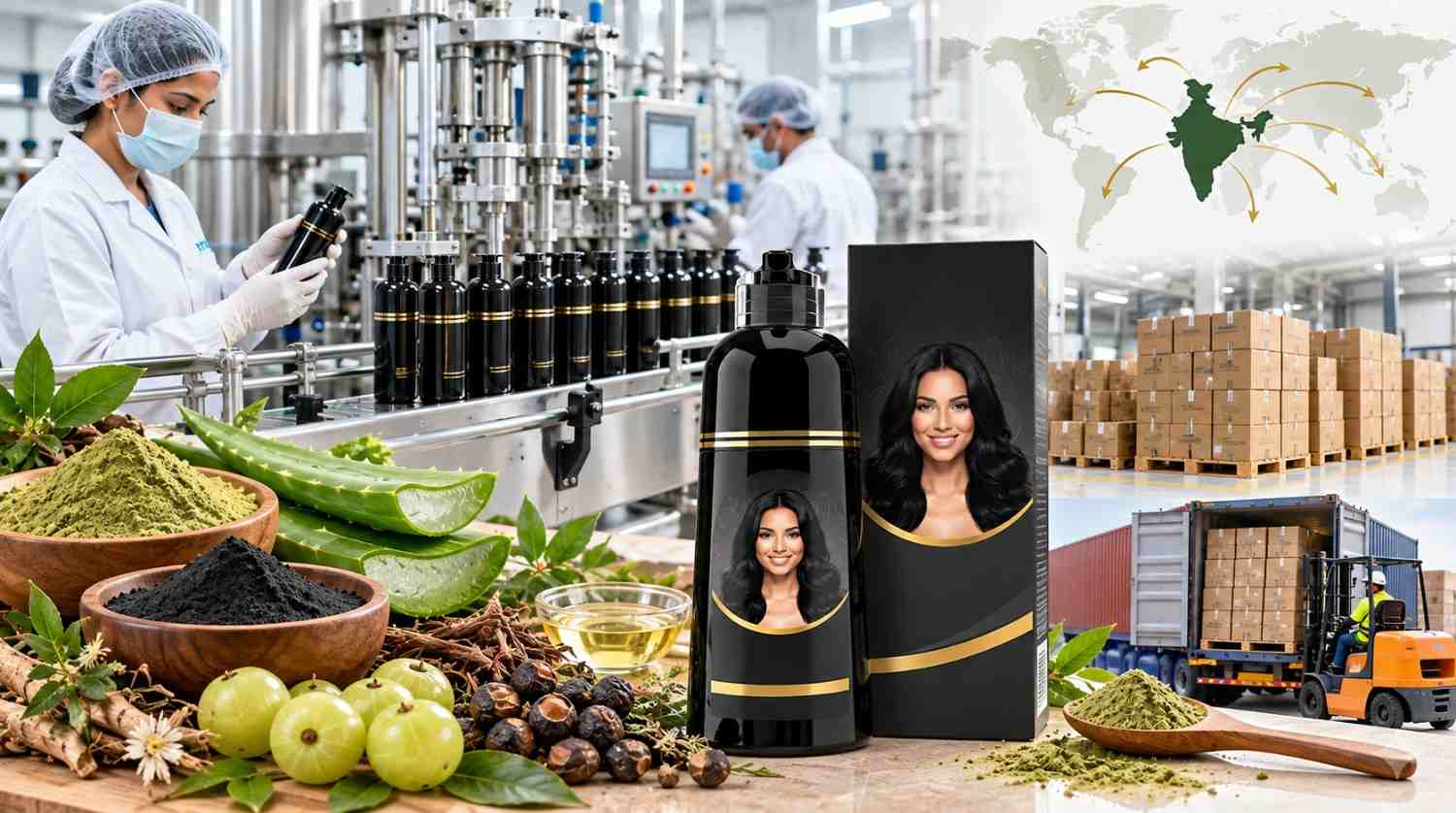
Hair color shampoo manufacturing and export sourcing: formulation, packaging, quality control and distribution.
India’s cosmetics manufacturing sector offers sourcing opportunities for domestic brands and international buyers. However, not every company advertising hair color shampoo is the actual manufacturer. Some are brand owners, traders, marketing companies or third-party manufacturing coordinators.
This 2026 sourcing guide explains how to distinguish these business models, evaluate product claims, compare OEM and private-label services, understand manufacturing quality requirements and build a practical procurement checklist.
Executive Summary: What Buyers Should Know
A suitable black hair color shampoo supplier should offer more than an attractive bottle and competitive quotation. Buyers need clear formulation information, reliable production arrangements, quality documentation, packaging specifications and consistent batch traceability. Important sourcing questions include whether manufacturing occurs in-house or through an approved third party, which quality standards apply, whether the formula is suitable for the destination market and how minimum order quantities are calculated. Ammonia-free and herbal-extract claims should be supported by the actual formulation. Hennahub India offers a black hair color shampoo product line and can be approached for product and sourcing enquiries. Before ordering, confirm current manufacturing arrangements, customisation options, pricing, lead times and regulatory documentation directly with the supplier.
1. Why Source Black Hair color Shampoo from India?
India has an established cosmetics and personal-care manufacturing ecosystem that serves both domestic and international markets. Buyers can explore finished branded products, contract manufacturing, private-label development and bulk distribution arrangements.
For a new hair color brand, India may offer access to formulation development, packaging suppliers, cosmetic manufacturing facilities and export-oriented businesses within one sourcing market.
However, availability of these services varies widely. A supplier capable of delivering a standard black color shampoo may not be equipped to develop a completely new formula or support registration in every destination country.
Who typically buys hair color shampoo in bulk?
Beauty Brand Owners
Businesses launching their own black hair color shampoo under a new or established trademark.
Wholesalers and Distributors
Companies purchasing finished products for resale through retail and distribution networks.
International Importers
Buyers sourcing products for markets that may require local registration, language-specific labels and import documentation.
Ecommerce Sellers
Businesses evaluating finished products or private-label opportunities for online marketplaces.
Salon Supply Businesses
Professional distributors seeking convenient hair coloring formats for their customer base.
Private-Label Startups
Entrepreneurs seeking formulation, packaging, brand presentation and manufacturing support.
What is changing in the 2026 sourcing conversation?
Buyers increasingly ask suppliers about convenience-oriented product formats, ingredient transparency, ammonia-free positioning, packaging quality and the practical difference between hair color shampoos and conventional hair dyes.
These are useful product-development themes, but they should not be mistaken for verified market growth statistics. Commercial demand, category size and growth rates require current market research before being quoted in a business plan.
2. Understanding Different Types of Hair color Shampoo Suppliers
One of the most important sourcing decisions is determining who actually manufactures the product.
Direct manufacturers
Direct manufacturers operate or control a licensed production facility and perform manufacturing activities within the scope of their capabilities and approvals.
They may offer established formulations, custom development or both. Buyers should confirm the exact manufacturing site and the activities performed there.
Third-party manufacturing companies
Third-party manufacturers produce goods for another company’s brand. The brand owner may handle marketing, distribution and product specifications while the manufacturer handles production.
This model can be appropriate for businesses that do not want to invest in their own manufacturing facility.
Private-label suppliers
Private-label suppliers may provide an existing formulation that can be sold under a buyer’s brand, subject to agreed packaging, labelling and regulatory requirements.
This can reduce development complexity, although buyers may have less flexibility to change the formulation.
Traders and exporters
Traders and exporters may source products from manufacturers and manage commercial supply, documentation or logistics.
A trading model is not inherently unsuitable. The key is transparency about the actual manufacturer, batch traceability and responsibility for quality issues.
3. What Makes a Top Black Hair color Shampoo Manufacturer?
The term “top manufacturer” should be based on measurable sourcing criteria rather than advertising claims.
A supplier may be suitable for a small domestic private-label order but less suitable for a complex export project requiring extensive testing, regulatory dossiers and destination-specific packaging.
Seven practical evaluation criteria
- Manufacturing transparency: Clear identification of the production facility and responsible legal entities.
- Formulation expertise: Ability to explain the dye mechanism, ingredient system and intended performance.
- Quality systems: Documented manufacturing controls, batch records and testing arrangements.
- Product consistency: Repeatable appearance, viscosity, color development and packaging quality across batches.
- Commercial flexibility: Suitable MOQs, packaging formats and order terms.
- Regulatory readiness: Appropriate licences, labels and supporting documents for the destination market.
- Communication and after-sales support: Clear technical responses, complaint handling and traceability.
Why the lowest price is not always the best offer
A lower quotation may exclude packaging development, testing, printing plates, regulatory documentation, freight or other services.
Two suppliers quoting the same bottle size may also use different formulations, packaging materials and quality specifications.
Buyers should compare offers on an equivalent specification basis before selecting a manufacturer.
4. Hennahub India: Black Hair color Shampoo Sourcing Option
Hennahub India is an Indian herbal products business serving manufacturing, wholesale and export markets. Its product portfolio includes natural herbal powders, henna-based products and hair coloring products.
The company’s black hair color shampoo line is presented as a convenient home-coloring product for adults seeking a natural black appearance.
Hennahub Black Hair color Shampoo — Product Overview
| Product attribute | Product information |
|---|---|
| Brand | Hennahub |
| Product category | Hair color shampoo |
| color | Natural Black |
| Pack size | 400ml |
| Product positioning | Ammonia-free and paraben-free; confirm current ingredient declaration |
| Botanical positioning | Natural extracts; exact extracts should be verified from the label |
| coloring time | Marketed with a 10-minute application direction; follow the final label |
| Accessories | Protective gloves included, subject to current pack configuration |
| Target customers | Adult men and women seeking black hair coloring |
| B2B availability | Contact Hennahub to confirm current bulk supply and custom manufacturing options |
Buyers can review the product through the Hennahub India product page or the international product information page.
What should a wholesale buyer request from Hennahub?
- Current product specification and complete ingredient declaration.
- Available bulk quantities and applicable minimum order quantities.
- Manufacturing entity and facility details.
- Private-label or OEM availability, if required.
- Packaging and carton specifications.
- Available testing and quality documents.
- Production lead time and export shipping terms.
- Destination-market documentation support.
These details should be confirmed before making commercial commitments. A public product listing does not, by itself, establish that every customisation or export service is available for the product.
5. Hair color Shampoo Formulations: What B2B Buyers Need to Understand
Black hair color shampoo is not one universal formula. Manufacturers may use different coloring systems, conditioning ingredients, pH controls and packaging arrangements.
Oxidative hair coloring systems
Some hair color products use dye precursors that react with an oxidising agent to form colored molecules. The formulation may require controlled mixing or a specific application system.
Buyers should understand how the product is supplied, whether components must be combined, and how the manufacturer validates stability and performance.
Direct-dye systems
Direct dyes contain preformed pigments that can deposit onto or within the hair fibre. These systems may be used for temporary color or color maintenance, depending on the formulation.
Their ability to cover resistant grey hair should be demonstrated through suitable product testing rather than assumed.
Ammonia-free black hair color shampoo
Ammonia-free products do not contain ammonia as a deliberately added ingredient. However, they may contain alternative alkalising agents or other conventional hair dye ingredients.
An ammonia-free claim does not automatically mean the product is free from allergens, non-irritating or harmless to hair.
Paraben-free formulations
A paraben-free formulation excludes that family of preservatives as formulated. Other preservatives may still be necessary, depending on the product’s composition and microbial risk.
Botanical extracts and conditioning ingredients
Some hair color shampoos contain botanical extracts, oils or conditioning agents to support the intended cosmetic experience.
A formulation containing plant extracts is not necessarily a completely plant-based dye. The substances responsible for producing black color should be identified separately from ingredients used for conditioning.
What about argan oil and 3-in-1 claims?
Argan oil and combined shampoo-conditioner-color positioning may be relevant to certain formulations. However, buyers should not assume these features are present in every hair color shampoo.
Request the complete ingredient list and a written explanation of the product’s intended functions before making such claims on private-label packaging.
6. How Black Hair color Shampoo Is Manufactured
Manufacturing methods depend on the dye system, product format and facility equipment. The following is a general overview of common cosmetic manufacturing activities rather than a description of a specific Hennahub production line.
Step 1: Product specification and formulation design
Development begins with the target shade, application method, processing time, packaging format and applicable regulatory requirements.
The formulation team considers ingredient compatibility, pH, viscosity, stability and intended coloring performance.
Step 2: Raw material qualification
Ingredients and packaging materials should be sourced against defined specifications. Incoming materials may require identity checks, documentation review and other testing appropriate to their risk.
Step 3: Controlled manufacturing
Production involves measured dispensing, mixing and process controls appropriate to the formula. Certain reactive systems may require separate components or special handling.
Step 4: In-process quality checks
Manufacturers may monitor appearance, viscosity, pH, mixing consistency and other defined parameters during production.
Step 5: Filling and sealing
Finished product or separate components are filled into compatible packaging. Fill quantity, closure performance and packaging integrity should be checked.
Step 6: Labelling and carton packing
Labels should carry the information required by the intended market. Cartons must be appropriate for handling, warehousing and transport.
Step 7: Finished-product release
Product release should follow documented acceptance criteria, with batch records and test results reviewed by the responsible quality function.
7. Quality Control and Testing for Hair color Shampoo
Quality assurance is especially important for hair coloring products because consumers may apply them directly to the scalp and hair.
The required testing programme depends on the formulation, manufacturing process, regulatory classification and destination market.
| Quality parameter | Why it matters | Typical evidence to request |
|---|---|---|
| Appearance and color | Helps identify visible variation between batches | Approved product specification and batch inspection record |
| pH | Relevant to formulation behaviour and intended use | Batch test result within approved limits |
| Viscosity | Influences dispensing, spreading and product consistency | Viscosity specification and batch result |
| Microbiological quality | Supports control of microbial contamination | Microbiological test report appropriate to the product |
| Stability | Evaluates product behaviour during storage | Stability protocol and available study summary |
| Packaging compatibility | Helps identify interactions between formula and container | Compatibility or packaging validation records |
| color performance | Supports intended shade and application claims | Documented performance test method and results |
| Fill quantity | Supports correct net content declaration | Filling and inspection records |
| Batch traceability | Supports investigation and recall procedures | Batch coding and manufacturing records |
COA, SDS and technical specifications
Buyers commonly request a Certificate of Analysis (COA), Safety Data Sheet (SDS), technical data sheet or product specification.
These documents serve different purposes. A COA reports defined test results for a particular batch or material. An SDS communicates relevant hazard and handling information where applicable. A technical specification describes the agreed product characteristics.
Buyers should confirm that the documents correspond to the actual ordered product and manufacturing batch.
What does ISO 22716 mean?
ISO 22716 provides guidelines for good manufacturing practices in the cosmetics industry. It addresses aspects of production, control, storage and shipment.
Buyers should verify the scope, validity and issuing organisation of any certification presented by a supplier. A certificate covering one facility or activity should not automatically be treated as covering every product.
Is a laboratory report proof of zero allergy risk?
No. Routine batch quality testing cannot guarantee that a hair dye will not cause allergic reactions in susceptible consumers.
Safety assessment, ingredient restrictions, warning labels and appropriate use instructions remain essential.
8. OEM and Private-Label Hair color Shampoo Manufacturing in India
OEM and private-label services can help beauty businesses enter the market without building their own production facilities.
What is OEM hair color shampoo manufacturing?
Original Equipment Manufacturing generally refers to production performed by a manufacturer for another business under agreed product and commercial specifications.
The buyer may control branding, certain specifications or development requirements, depending on the contract.
What is private-label manufacturing?
Private label commonly involves supplying an existing or adapted formulation under the buyer’s brand name.
It may be faster to commercialise than a completely new formulation, although the buyer should confirm exclusivity, ingredient disclosure and regulatory responsibilities.
| Factor | Private Label | Custom OEM Development |
|---|---|---|
| Starting formula | Usually existing or lightly adapted | May be newly developed or substantially modified |
| Development complexity | Often lower | Often higher |
| Packaging flexibility | Depends on supplier options | Can be broader, subject to tooling and MOQ |
| Testing requirements | Must support the final marketed product | May require additional development and validation testing |
| Time to launch | May be shorter | May be longer |
| Best suited for | Brands seeking an established product concept | Brands with specific formulation or differentiation goals |
Questions to ask before starting a private-label project
- Can the supplier provide an existing approved formulation?
- Can the formula be customised, and what testing would be required?
- Who owns the formulation and related intellectual property?
- Which company appears as manufacturer on the label?
- Who is responsible for regulatory compliance in the destination market?
- What are the minimum quantities for bottles, cartons and printed labels?
- Are development, artwork, tooling and testing charges separate?
- What happens if a batch fails agreed specifications?
Businesses exploring these arrangements can contact Hennahub India to discuss whether the required product and service model is currently available.
9. Packaging Options for Black Hair color Shampoo
Packaging influences product protection, shelf presentation, shipping efficiency and the customer experience.
A suitable package must be compatible with the formulation and designed for its actual dispensing and storage requirements.
400ml bottle packaging
The 400ml format is relevant for buyers considering a consumer retail product with a substantial declared quantity.
However, the bottle size alone does not determine the number of applications. Usage depends on the recommended quantity per treatment and the consumer’s hair length and density.
Single-component vs multi-component packaging
Some hair coloring systems can be supplied as a single product, while others require separate components that are combined during use.
Buyers should confirm whether the proposed packaging protects the formulation throughout its intended shelf life.
Retail carton and master carton requirements
A retail carton may communicate product information, usage directions and brand identity. A master carton supports bulk handling, storage and transportation.
Export buyers should review carton dimensions, gross weight, bottle orientation, leakage resistance and palletisation requirements.
Important label information
- Product identity and intended shade.
- Net quantity.
- Complete ingredient declaration in the required format.
- Directions for use and relevant warnings.
- Manufacturer or responsible-person information as applicable.
- Batch identification.
- Expiry, durability or period-after-opening information where required.
- Country-specific importer or responsible-party details.
Local labelling requirements vary. An Indian retail label should not automatically be reused unchanged for the United States, European Union, Gulf markets or other destinations.
10. MOQ, Wholesale Pricing and Production Lead Times
Minimum order quantity, or MOQ, is one of the first commercial questions asked by distributors and private-label buyers.
There is no single standard MOQ for all Indian hair color shampoo manufacturers. It may depend on the formulation, packaging components, production batch size and level of customisation.
What determines the MOQ?
- Minimum practical production batch size.
- Bottle and closure procurement quantities.
- Printed label and carton production requirements.
- Custom formulation development needs.
- color or fragrance variants.
- Export-specific artwork and documentation.
What determines the wholesale price?
Pricing should be evaluated as a complete cost structure rather than a single bottle price.
| Cost component | What it covers | Buyer consideration |
|---|---|---|
| Formula and ingredients | coloring system and supporting cosmetic ingredients | Compare equivalent formulation specifications |
| Bottle and closure | Primary packaging | Check material, compatibility and weight |
| Label and carton | Printed retail packaging | Confirm artwork, printing and language requirements |
| Manufacturing and filling | Production labour, equipment and process costs | Clarify what is included in the unit price |
| Quality testing | Routine and additional agreed testing | Identify separate testing charges |
| Development charges | Custom formulation, samples and validation | Ask about one-time costs |
| Logistics | Inland transport, export handling and freight | Compare quotations under the same Incoterm |
How long does production take?
Lead time depends on raw material availability, packaging procurement, artwork approval, production scheduling and required testing.
A repeat order using existing packaging may move differently from a first private-label order requiring new labels, cartons and regulatory review.
Ask the supplier to separate development time, packaging preparation, manufacturing, quality release and dispatch in the quotation.
11. Exporting Black Hair color Shampoo from India
Export sourcing adds another layer of responsibility because the product must meet the rules of the destination market as well as applicable Indian requirements.
India’s cosmetic manufacturing framework
Cosmetics manufactured in India are subject to applicable legal requirements, including the Drugs and Cosmetics Act framework and the Cosmetics Rules, 2020, as amended.
Buyers should verify the relevant manufacturing licence, approved activities and any other permissions applicable to the product and facility.
Official regulatory information is available through the Central Drugs Standard Control Organization (CDSCO).
United States
The United States has specific rules for cosmetics, including requirements that may arise under the Modernization of Cosmetics Regulation Act of 2022 (MoCRA).
Whether a particular product or business must meet a specific registration, listing, labelling or other requirement depends on the facts and applicable exemptions.
Hair dye products also raise ingredient and warning considerations. Buyers should review FDA hair dye guidance and current regulatory requirements before importing.
European Union
Cosmetics placed on the EU market generally require an appropriate responsible person, a safety assessment, product information file, notification and compliant labelling under Regulation (EC) No 1223/2009.
Hair dye ingredients may be subject to restrictions and specific warnings. A product compliant in India is not automatically compliant in the EU.
Refer to the EU Cosmetics Regulation for the legal framework.
Gulf and other international markets
Gulf countries and other importing markets may have their own product registration, conformity, labelling and importer requirements.
Importers should confirm the current rules with the competent local authority or qualified regulatory adviser before approving the final packaging.
Common export documents
Depending on the shipment and destination, buyers may require:
- Commercial invoice.
- Packing list.
- Shipping bill or export customs documentation.
- Bill of lading or air waybill.
- Certificate of origin, when required.
- Product specification and ingredient declaration.
- Available COA and relevant safety documentation.
- Free Sale Certificate or other market-specific documentation, when applicable.
- Import permits, registration records or other destination-specific approvals.
What is the HS code for hair color shampoo?
Classification depends on the product’s composition, function and applicable customs tariff rules. Hair coloring preparations and shampoos can fall under different tariff headings.
Buyers should not select an HS code solely because the product name contains the word “shampoo.” Confirm classification with a customs professional or the relevant customs authority.
EXW, FOB and CIF: What buyers should know
EXW generally places extensive collection and transportation responsibilities on the buyer. FOB and CIF are maritime Incoterms with different allocations of cost and responsibility.
For air shipments, terms designed for any mode of transport may be more appropriate. Always specify the Incoterms version and named place or port in the contract.
Refer to the International Chamber of Commerce Incoterms resources for authoritative guidance.
12. How to Compare Hair color Shampoo Manufacturers in India
Rather than relying on an unverified list of “top ten” manufacturers, use a structured comparison to identify the supplier that best matches your requirements.
| Evaluation factor | What to verify | Recommended evidence |
|---|---|---|
| Business identity | Legal entity and role in the supply chain | Company registration and written business details |
| Manufacturing facility | Actual production site and activities | Applicable licence and facility details |
| Product formulation | color system, ingredients and intended claims | Specification, ingredient list and sample |
| Quality controls | Batch testing, traceability and release process | COA, quality procedures and relevant records |
| Private label | Branding and customisation options | Written scope and artwork requirements |
| Packaging | Available bottle, carton and shipping formats | Packaging specification and physical samples |
| Commercial terms | MOQ, price, payment and lead time | Formal quotation or proforma invoice |
| Export readiness | Ability to supply relevant documents and labels | Document checklist and compliance responsibilities |
| Complaint handling | Process for quality issues and defective goods | Written terms and complaint procedure |
Should you visit the factory?
For large orders or long-term partnerships, a factory visit or independent audit can provide valuable insight into the manufacturing environment and quality practices.
Where a physical visit is impractical, request a structured virtual walkthrough and supporting documentation. Videos and photographs are useful but should not replace independent verification when risk is high.
13. Step-by-Step Guide to Sourcing Hair color Shampoo in Bulk
Specify the intended shade, pack size, application method, positioning, target market and any essential formulation restrictions.
Search for direct manufacturers, private-label providers and export suppliers. Record the actual manufacturing arrangements rather than relying only on website claims.
Include expected quantity, destination country, packaging preference, documentation requirements and whether you need an existing formula or custom development.
Review the product specification, ingredient declaration, application directions and relevant testing information.
Assess packaging, appearance, dispensing, instructions and documented color performance. Use appropriate controlled testing rather than informal claims.
Determine who is responsible for destination-market assessment, notification, labelling and any required registration.
Agree on the exact formulation reference, packaging materials, quantity, quality criteria, pricing, payment terms and delivery conditions.
Check ingredient declarations, claims, directions, warnings, manufacturer details and language requirements.
Confirm the manufacturing schedule and inspection or testing arrangements before dispatch.
Verify invoice, packing list, batch details and any required import or export documents before goods leave the facility.
14. Common Mistakes When Choosing a Hair color Shampoo Supplier
- Choosing solely on price: A low unit cost may exclude important packaging, testing or compliance expenses.
- Confusing a trader with a manufacturer: Buyers may misunderstand who controls the production process.
- Skipping sample approval: Product appearance, packaging and performance may not match expectations.
- Assuming ammonia-free means risk-free: Hair coloring products can still contain potential allergens.
- Making unsupported claims: Five-minute results, full grey coverage or damage-free coloring should not be claimed without appropriate evidence.
- Ignoring destination regulations: A product accepted in one country may require changes before entering another.
- Failing to agree on specifications: Vague purchase orders can create disputes about packaging, ingredients or quality.
- Not checking packaging compatibility: An attractive bottle may be unsuitable for a particular formulation.
- Overlooking batch traceability: Poor traceability makes complaints and corrective actions harder to manage.
- Ordering before final artwork approval: Packaging corrections after printing can create avoidable delays and costs.
15. Hair color Shampoo Manufacturing: Myths vs Facts
| Myth | Fact |
|---|---|
| Every supplier calling itself a manufacturer owns a factory. | Some businesses use third-party manufacturing or trading arrangements. |
| Ammonia-free hair color contains no chemicals. | It may contain other coloring ingredients and alkalising agents. |
| All black hair color shampoos use the same formula. | Formulations, dye systems and performance characteristics can differ. |
| Private-label manufacturing requires no regulatory work. | The final marketed product must still meet applicable requirements. |
| A COA proves the product cannot cause allergies. | Routine quality tests cannot guarantee the absence of allergic reactions. |
| The cheapest quotation gives the best margin. | Total cost includes packaging, testing, logistics, compliance and quality risk. |
| One label can be used in every country. | Different markets may require different warnings, languages and responsible-party information. |
| All instant hair color products work in five minutes. | Processing time depends on the specific tested formulation. |
16. Frequently Asked Questions
1. Who manufactures black hair color shampoo in India?
India has businesses involved in direct cosmetics manufacturing, contract manufacturing, private-label supply and hair color product distribution. Hennahub India is one company offering a black hair color shampoo product line and related sourcing enquiries. Buyers should verify the actual manufacturing entity and facility for each proposed product. A supplier’s marketing website alone is not sufficient evidence of in-house production or a particular manufacturing licence.
2. How can I find a reliable black hair color shampoo manufacturer in India?
Start with the supplier’s legal identity, production arrangements and relevant manufacturing approvals. Request samples, a full ingredient declaration, product specifications and available quality documentation. Compare pricing only after defining equivalent packaging and quality requirements. For significant orders, consider a factory audit or independent inspection. Confirm who is responsible for formulation compliance, batch release, complaints and any destination-market registration before placing the purchase order.
3. Does Hennahub India supply black hair color shampoo in bulk?
Hennahub India offers a black hair color shampoo product line and provides business contact channels for wholesale and export enquiries. Buyers can review the product information and contact the company to confirm current bulk availability, pricing, packaging and lead time. Any private-label, OEM or custom formulation requirement should be discussed separately rather than assumed to be available for every order.
4. What is the minimum order quantity for private-label hair color shampoo?
MOQ varies with production batch size, packaging materials, formulation requirements and printing arrangements. A standard product with existing packaging may have different commercial requirements from a custom bottle, label or formula. Request a written quotation for your specific quantity and packaging configuration. The supplier should also clarify whether the MOQ applies per color, formulation, label design or complete order.
5. Can I launch my own hair color shampoo brand using an Indian manufacturer?
Yes, private-label and contract manufacturing models can support the launch of a new brand, subject to the supplier’s capabilities and applicable legal requirements. You will need to agree on formulation, packaging, brand artwork, product claims, testing and commercial terms. The company responsible for placing the product on the market must also address relevant compliance obligations. Ask the supplier to explain which responsibilities it accepts and which remain with your brand.
6. Is ammonia-free black hair color shampoo completely safe?
No hair coloring product should be described as completely risk-free. Ammonia-free means ammonia is not deliberately included in the formulation, but other ingredients may still cause irritation or allergic reactions. Some products contain oxidative dye ingredients or alternative alkalising agents. Buyers should assess the complete formulation, product warnings and relevant safety documentation. Consumers must follow the manufacturer’s allergy precautions and application instructions.
7. What documents should I request from a hair color shampoo manufacturer?
Ask for the product specification, ingredient declaration, applicable manufacturing licence information, available batch COA, packaging details and relevant safety or technical documents. Depending on the market, additional records may be needed for safety assessment, product registration or labelling. For export orders, commercial invoices, packing lists and shipment documents are also relevant. The exact documentation package should be agreed before production begins.
8. Can black hair color shampoo be exported from India to the USA?
Export may be possible when the product and responsible businesses meet applicable requirements. The United States has specific rules concerning cosmetics, hair dyes, labelling and certain obligations under MoCRA. The importer and responsible parties should assess the exact product and any exemptions or special requirements. Do not assume that Indian market compliance automatically establishes US compliance. Review current FDA guidance and obtain qualified regulatory advice when necessary.
9. What is the difference between OEM and private-label hair color shampoo?
Private label commonly involves selling an established formulation under another brand, with agreed packaging and labelling. OEM arrangements may involve more extensive product specifications or custom development, depending on the contract. Both models require clear quality responsibilities, documentation and compliance planning. The most suitable option depends on your budget, differentiation goals, launch schedule and desired level of formulation control.
10. Can a manufacturer develop a five-minute black hair color shampoo?
Some quick-coloring products are marketed with five-minute directions, but achieving and substantiating a specific processing time depends on formulation development and performance testing. Buyers should request evidence supporting the claimed results on intended hair types. A supplier offering a ten-minute product should not automatically advertise it as a five-minute formula. The approved instructions must match the actual product and supporting data.
11. What packaging is suitable for 400ml hair color shampoo?
Packaging selection depends on the formulation’s chemical compatibility, dispensing needs, stability and intended market. Buyers may consider bottles, closures, labels, retail cartons and master cartons, but each component should be evaluated against the actual product. Confirm net content, leakage resistance, transport performance and mandatory label information. Packaging that works for an ordinary cleansing shampoo may not be suitable for every reactive hair coloring formulation.
12. How do I compare wholesale hair color shampoo prices from Indian suppliers?
Request quotations based on the same formulation specification, net content, packaging, order quantity, quality requirements and delivery term. Identify whether the price includes artwork, testing, printed cartons, taxes, inland transport or export freight. Compare payment terms and lead times as well as unit cost. A supplier offering a slightly higher price may provide better overall value if its documentation, packaging quality and supply reliability are stronger.
17. Key Takeaways for B2B Buyers
- Choose suppliers using verifiable manufacturing and quality criteria rather than promotional rankings.
- Confirm whether the company is a direct manufacturer, third-party coordinator, private-label supplier or exporter.
- Request product-specific documentation and samples before placing a commercial order.
- Evaluate the full formulation instead of relying only on ammonia-free or herbal marketing terms.
- Compare quotations using equivalent packaging, testing, quantity and delivery terms.
- Clarify who is responsible for destination-market regulatory compliance.
- Confirm OEM and private-label availability before planning a custom brand launch.
- Prioritise batch traceability, packaging compatibility and consistent product quality.
18. Conclusion: Choosing the Right Manufacturing Partner
Finding a suitable black hair color shampoo manufacturer in India requires more than searching for the lowest price or the largest product catalogue.
A reliable sourcing decision considers formulation quality, manufacturing transparency, batch documentation, packaging, commercial terms and the regulatory requirements of the destination market.
For brand owners, wholesalers and importers, a structured supplier evaluation can reduce avoidable problems and support a more consistent long-term supply relationship.
Hennahub India is one option for buyers exploring black hair color shampoo products and related commercial enquiries. Prospective customers should request current specifications and confirm the exact supply arrangement before ordering.
Explore Hennahub Black Hair color Shampoo
Looking for a 400ml black hair color shampoo for your retail portfolio, wholesale business or international distribution project?
Explore Hennahub’s product information and available retail channels below. For bulk purchasing, private-label possibilities or export requirements, contact Hennahub directly for current commercial and technical details.
B2B Product and Company Links
Retail and Marketplace Listings
Marketplace availability, seller details, pricing and product specifications may change. Confirm current information before purchasing.
19. Authoritative References and Further Reading
Manufacturers and importers should use official regulatory information and relevant technical standards when evaluating a hair coloring product.
- Central Drugs Standard Control Organization (CDSCO): Official Indian regulatory authority. Reference point for Indian cosmetics regulatory information and applicable rules.
- U.S. Food and Drug Administration: Hair Dyes. Official guidance on hair dye products, ingredients and safety considerations.
- U.S. Food and Drug Administration: Modernization of Cosmetics Regulation Act of 2022. Information on the current US cosmetics regulatory framework.
- European Union: Regulation (EC) No 1223/2009 on Cosmetic Products. Legal framework governing cosmetics placed on the EU market.
- International Organization for Standardization: ISO 22716 — Cosmetics Good Manufacturing Practices. International guidance on cosmetics manufacturing practices.
- International Chamber of Commerce: Incoterms Rules. Authoritative information on international commercial delivery terms.
- PubMed: Scientific research on oxidative hair dye chemistry. Research literature concerning color development and hair dye ingredients.
This article is a commercial sourcing guide published for Hennahub India. It does not constitute an independent ranking of manufacturers, a certification of any production facility or legal advice. Verify current regulatory requirements, product specifications and supplier documentation before entering a supply agreement.