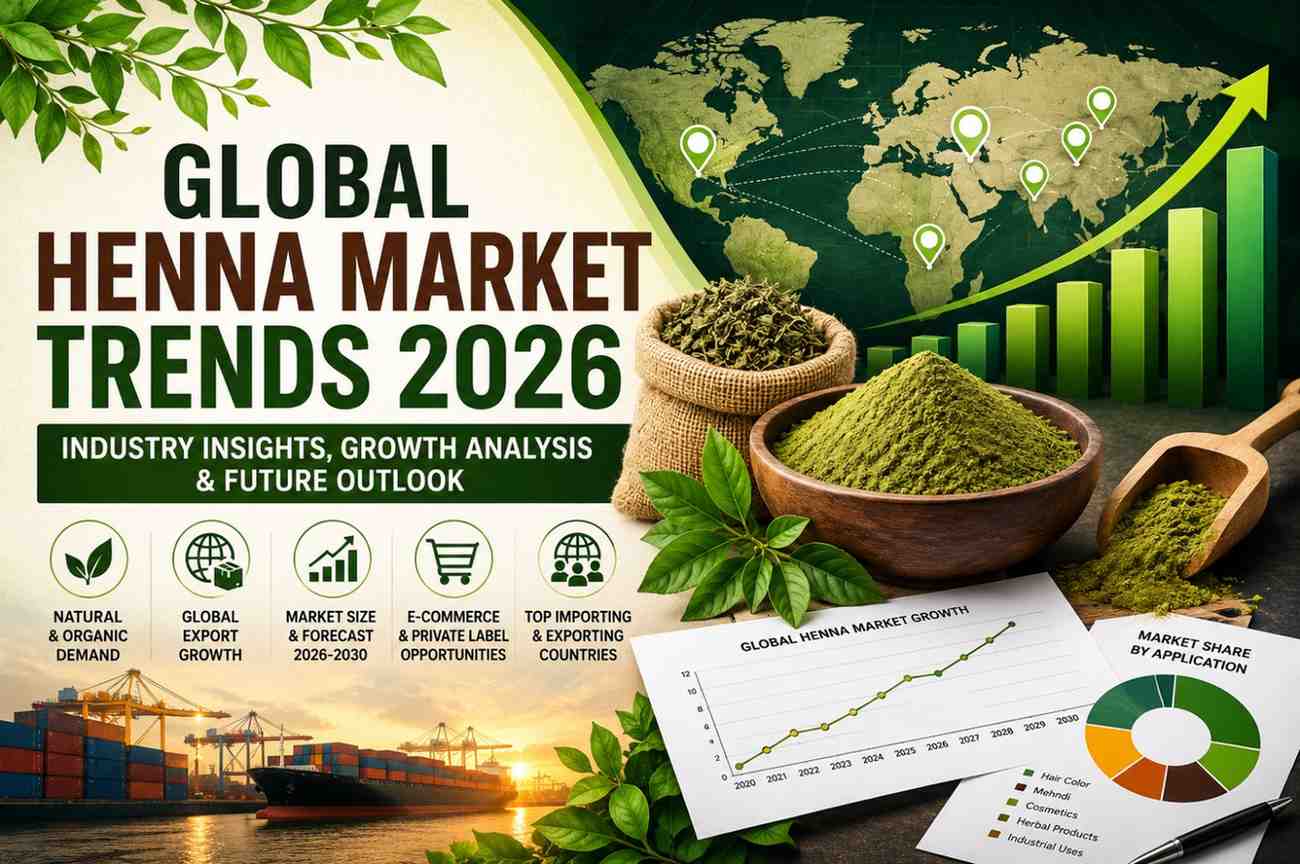

Global Henna Market Trends 2026: Complete Industry Analysis, Export Data & Future Growth Forecast
Updated June 2026 · Industry Research · 14 min read
Table of Contents
ToggleExecutive Summary: Global Henna Market at a Glance
The global henna market was valued at approximately USD 1.5 billion in 2024 and is forecast to reach USD 2.2–2.6 billion by 2033–2035, growing at a compound annual growth rate (CAGR) of roughly 4.4% to 5.9% depending on segment and region. India dominates global production with approximately 80% of world supply, with the Sojat region of Rajasthan alone responsible for the majority of India’s output. Pakistan, Egypt, Sudan, Yemen, and Morocco are secondary producers, mostly serving regional and body-art-focused export markets. On the demand side, Japan, the United States, and the United Arab Emirates together account for roughly 65% of India’s henna powder exports, with the Middle East, North America, and Europe representing the fastest-growing import regions. Growth is being driven by the global shift toward chemical-free, ammonia-free hair color, the organic beauty movement, and the rapid expansion of cross-border ecommerce on platforms like Amazon and Shopify. The biggest opportunities for 2026 and beyond lie in private label manufacturing, organic certification, premium export packaging, and direct-to-consumer brand building for natural hair care.
Table of Contents
- What Is the Global Henna Market?
- Global Henna Industry Overview
- Henna Production by Country
- Top Henna Exporting Countries
- Top Henna Importing Countries
- Henna Market Size Forecast
- Cosmetic Industry Demand
- Natural Hair Color Trends
- Organic Beauty Market Influence
- Ecommerce Growth Impact
- Private Label Opportunities
- Future Industry Forecast (2026–2030)
- Frequently Asked Questions
- Conclusion
1. What Is the Global Henna Market?
The global henna market covers the cultivation, processing, trade, and end use of Lawsonia inermis, a flowering shrub whose dried, ground leaves yield the reddish-brown dye known as henna powder. For centuries henna has been used across South Asia, the Middle East, and North Africa for temporary body art (mehndi), hair conditioning, and as a natural dye in textiles. The “global henna market” as tracked by industry analysts now spans several distinct product categories: raw henna leaf, sieved henna powder, henna paste and cones for body art, henna-based hair color and conditioning powders, and henna extracts used in cosmetic and herbal formulations.
Modern applications have expanded well beyond traditional mehndi. Henna powder is now a core ingredient in chemical-free hair color lines, scalp care treatments, herbal hair masks, and even private-label cosmetic products sold across Amazon, Shopify, Etsy, and Flipkart. This shift from a purely cultural product to a globally traded herbal beauty commodity is the single biggest structural change in the industry over the past decade.
From a trade classification standpoint, the market is generally segmented by product form (raw leaf, sieved powder, paste, cones, liquid extract), by grade (standard, premium, organic-certified), and by end-use category (body art, hair color, cosmetics, herbal/wellness, and small-scale industrial or textile dye applications). Buyers sourcing for different segments typically prioritize different attributes: mehndi and body-art buyers care most about dye intensity and fineness, while cosmetic and hair-color formulators increasingly prioritize certified-organic status, documented purity, and consistent batch-to-batch quality for regulatory compliance.
2. Global Henna Industry Overview
Industry research firms place the global henna powder market at approximately USD 1.5 billion in 2024, with projections reaching USD 2.2 billion by 2033 at a CAGR near 5.2%. A broader henna/mehndi market category (which includes body-art cones and paste products) was valued at roughly USD 1.26 billion in 2023, with forecasts of USD 2.10 billion by 2032 (CAGR 4.4%), and some longer-range models projecting a CAGR as high as 5.9% through 2035. While exact figures vary by research methodology, the consistent signal across reports is mid-single-digit-to-high-single-digit annual growth sustained through the end of the decade.
Regionally, Asia-Pacific remains the largest production and consumption base, valued at roughly USD 0.45 billion in 2024 and projected to reach USD 0.75 billion by 2033. North America, while a smaller base at approximately USD 0.15 billion in 2024, is growing steadily toward an estimated USD 0.23 billion by 2033, fueled almost entirely by demand for natural hair color and organic personal care imports rather than domestic cultivation.
Structurally, the industry remains fragmented at the production level — dominated by thousands of smallholder farmers and hundreds of small-to-mid-sized processing units, particularly around Sojat — while becoming increasingly consolidated at the brand and retail level, where a smaller number of established exporters, private-label manufacturers, and ecommerce-native brands capture a disproportionate share of finished-goods revenue. This dynamic mirrors other agricultural-commodity-to-consumer-brand transitions (coffee, spices, essential oils), where the biggest long-term value capture shifts from raw material supply toward formulation, certification, and brand-building.
3. Henna Production by Country
Global henna cultivation is geographically concentrated. India is by far the dominant producer, commercial henna farming is also established in Pakistan, Egypt, Sudan, Yemen, Iran, Morocco, and parts of Niger and Somalia — though at a fraction of India’s scale.
| Country | Production Level | Key Growing Regions | Export Potential |
|---|---|---|---|
| India | Very High (~80% of global supply) | Sojat & Pali (Rajasthan), Gujarat, Tamil Nadu | Very High – exports to 130+ countries |
| Pakistan | Moderate | Sindh, Punjab | Moderate – regional & South Asian diaspora markets |
| Egypt | Low-Moderate | Upper Egypt, Nile Delta | Moderate – Middle East & tourism-linked exports |
| Sudan | Low | Northern Sudan | Niche – body-art specialty exports |
| Morocco | Low | Marrakech-Safi region | Niche – tourism & North African trade |
Why Sojat, India Is Considered the Henna Capital of the World
Sojat, a town in the Pali district of Rajasthan, is globally recognized as the “Henna Capital of the World.” Sojat and the surrounding Pali district account for roughly 80% of India’s total henna production, and since India itself supplies around 80% of global henna, Sojat alone effectively underpins a majority share of the world’s henna trade. Some regional sources place Sojat’s share of India’s output even higher, at over 90%.
The region’s semi-arid climate, sandy loam soil, and consistently warm, dry weather create ideal growing conditions that are difficult to replicate elsewhere — a key reason Sojat henna is prized for its dye intensity and purity. Over decades, Sojat has built a complete henna-processing ecosystem: cleaning units, grinding mills, moisture-controlled packaging facilities, in-house quality testing labs, and a dense network of brokers and exporters connecting this single Rajasthani town directly to buyers in the UAE, Saudi Arabia, the United States, the United Kingdom, and beyond. In recognition of its unique quality and heritage, Sojat henna received a Geographical Indication (GI) tag from the Government of India in 2010, formally protecting its name and provenance in global trade. Hennahub India, based directly in Sojat, sources and processes henna powder at the heart of this ecosystem.
Beyond climate and infrastructure, Sojat’s advantage is also reputational: decades of buyer relationships, an established base of English-speaking export staff, and direct familiarity with international documentation requirements (COA, phytosanitary certificates, certificates of origin) reduce friction for first-time international buyers compared to sourcing from less-established regions.
4. Top Henna Exporting Countries
India’s dominance is even sharper in finished henna powder exports than in raw cultivation. Trade data covering July 2024–June 2025 shows India responsible for 98% of global henna powder export shipments (3,208 of 3,274 total shipments worldwide), routed through 203 verified exporters to 631 international buyers — a 9% year-on-year increase in shipment volume. Pakistan, Egypt, Sudan, and Morocco make up the remainder of global exports, largely serving regional and specialty body-art markets rather than competing directly with India’s processed-powder trade.
5. Top Henna Importing Countries
Henna demand is global, but concentrated. India exports henna powder to more than 138 countries, with Japan, the United States, and the United Arab Emirates together absorbing roughly 65% of all exports. Recent shipment data (July 2024–June 2025) ranks Japan first with 508 shipments (25%), the United States second with 316 shipments (16%), and the UAE third with 306 shipments (15%). Saudi Arabia, Kuwait, Oman, and Qatar round out strong Gulf demand driven by mehndi traditions and wedding-season consumption, while the United Kingdom, Germany, France, South Korea, Singapore, Iraq, Taiwan, and Canada represent steadily growing markets for henna-based hair color and herbal cosmetics.
| Country | Demand Level | Primary Usage | Market Opportunity |
|---|---|---|---|
| Japan | Very High | Natural hair color, herbal cosmetics | High – premium chemical-free positioning |
| United States | Very High | Hair color, DIY/Etsy mehndi kits, wellness | Very High – ecommerce & private label |
| United Arab Emirates | Very High | Mehndi/body art, weddings, salons | High – bulk & B2B distribution |
| Saudi Arabia | High | Mehndi, traditional ceremonies | High – festival & wedding-season bulk orders |
| United Kingdom | Moderate-High | Natural hair color, South Asian diaspora | Moderate – retail & specialty stores |
| Germany | Moderate | Organic cosmetics, herbal hair care | Moderate – certified-organic demand |
6. Henna Market Size Forecast (2020–2030)
Modeling a blended growth path across the major industry reports, the global henna market has expanded steadily from the early 2020s and is projected to continue at a mid-single-digit CAGR through 2030, with cumulative growth accelerating slightly post-2026 as organic and private-label demand matures.
| Year | Estimated Market Size (USD Billion) | Estimated Growth % |
|---|---|---|
| 2020 | 1.05 | — |
| 2021 | 1.10 | 4.8% |
| 2022 | 1.17 | 6.4% |
| 2023 | 1.26 | 7.7% |
| 2024 | 1.35 | 7.1% |
| 2025 | 1.43 | 5.9% |
| 2026 | 1.52 | 6.3% |
| 2027 | 1.61 | 5.9% |
| 2028 | 1.71 | 6.2% |
| 2029 | 1.81 | 5.8% |
| 2030 | 1.92 | 6.1% |
Figures are blended estimates derived from multiple industry research reports (Verified Market Research, Valuates Reports, WiseGuy Reports) and should be treated as directional rather than audited financial data.
7. Cosmetic Industry Demand
Henna’s role inside the cosmetics and personal care industry has shifted from a single-use body-art product to a multi-category herbal ingredient. Formulators now blend henna with indigo, amla, bhringraj, and hibiscus to create chemical-free hair colors, scalp treatments, and conditioning masks marketed under both private-label and branded lines. This diversification is reflected in how henna volume is now split across end uses.
This diversification also means formulators are no longer treating henna as a single commodity input. Cosmetic chemists increasingly specify particle size distribution, pH-adjusted blends, and standardized lawsone concentration ranges when sourcing henna for mass-market hair color lines, pushing manufacturers toward more rigorous, lab-verified batch consistency than was historically expected in the traditional mehndi trade.
8. Natural Hair Color Trends
Henna’s biggest growth driver in 2026 is the global pivot toward chemical-free hair color. The organic hair color market is projected to reach approximately USD 1.38 billion in 2026, climbing to roughly USD 2.6 billion by 2035 at a 7.3% CAGR; some forecasts for the broader organic hair dye category project growth to USD 3.8 billion by 2034 at a CAGR of 9.2%. Consumer survey data consistently shows that over 65% of consumers now prefer plant-based hair colorant alternatives, with more than 42% of global consumers actively seeking ammonia-free and paraben-free formulations. In the United States alone, natural products are expected to account for roughly 40% of the hair color market by 2026.
This demand is strongest among millennials and Gen Z consumers prioritizing clean-label ingredients, with over 57% of women aged 25–45 actively seeking chemical-free alternatives to ammonia-based dyes. Henna and indigo-based formulations sit squarely at the center of this shift, since they deliver visible coverage and conditioning benefits without synthetic dyes.
9. Organic Beauty Market Influence
The broader organic and clean-beauty movement continues to pull henna further into mainstream retail. Certification bodies such as USDA Organic, ECOCERT, and India’s own organic standards are increasingly required by international buyers — particularly in the United States and European Union — before a henna shipment is even considered for B2B partnership. Manufacturers who invest early in organic certification, traceability documentation, and lab-verified Certificate of Analysis (COA) reports gain a structural advantage over uncertified bulk suppliers, since large retailers and private-label brands now treat certification as a baseline requirement rather than a premium feature.
The certification process itself typically involves farm-level documentation of soil and input history, segregated organic-handling procedures at the processing stage to prevent cross-contamination with conventional batches, annual third-party audits, and ongoing batch traceability records linking each shipment back to its source farms. While this adds cost and administrative overhead for manufacturers, it also creates a durable competitive moat: once a buyer has qualified a certified, audit-ready supplier, switching costs are high, which tends to produce longer-term, more stable B2B relationships than price-driven spot purchasing.
10. Ecommerce Growth Impact
Cross-border ecommerce has restructured how henna reaches end consumers. Where henna once moved almost exclusively through wholesale importers and traditional distributors, platforms like Amazon, Shopify, Etsy, Flipkart, and Meesho now let manufacturers in Sojat sell finished, retail-ready henna products directly to consumers in the US, UK, Germany, and beyond. This has compressed the supply chain, improved margins for manufacturers willing to invest in branding and compliance, and created an entirely new category of direct-to-consumer (DTC) natural hair care brands built around a single hero ingredient: henna.
For exporters, this means the highest-margin opportunity is no longer just selling 25kg bulk bags to importers — it is building Amazon-ready and Shopify-ready finished products (cones, sachets, retail tins) with optimized listings, professional packaging, and English-language compliance documentation that can be sold at retail price points internationally.
Social and content-driven commerce is reinforcing this shift further. Instagram, Pinterest, and YouTube tutorials demonstrating henna-based hair color application and mehndi designs now function as a discovery and trust-building layer ahead of the purchase itself, meaning brands that invest in consistent, benefit-led content alongside their product listings tend to convert better than those relying on marketplace search alone.
11. Private Label Opportunities
For henna manufacturers, the clearest path to higher margins in 2026 is private label and white label manufacturing for international cosmetic brands. Buyers increasingly want a turnkey partner who can supply organic-certified raw material, formulate finished products (hair color powder, henna cones, herbal shampoo bars), and private-label them under the buyer’s own brand — all backed by COA documentation and export-compliant packaging.
| Product Type | Market Demand | Profit Potential | Buyer Segment |
|---|---|---|---|
| Bulk Henna Powder (25kg bags) | High | Moderate | Wholesale importers, distributors |
| Retail Henna Powder (50–500g) | High | High | Amazon/Shopify DTC brands |
| Henna Cones | Very High (seasonal) | High | Etsy sellers, salons, event organizers |
| Herbal Hair Color (Henna+Indigo blends) | Very High | Very High | Private label cosmetic brands |
| Organic-Certified Henna | Growing rapidly | Very High | US/EU premium retailers |
Key levers for capturing this opportunity include pursuing recognized organic certification, investing in moisture-barrier “active packaging” that preserves dye potency across long ocean and air shipments, and using B2B digital platforms and trade directories to reach buyers directly rather than relying solely on intermediaries. Buy Henna Powder Online through verified manufacturer storefronts is also becoming a standard due-diligence step for international buyers vetting suppliers before placing bulk orders.
12. Future Industry Forecast: 2026–2030
Market drivers: Continued global demand for chemical-free hair color, rising organic and clean-beauty certification requirements, growth of cross-border ecommerce, and increasing wedding/festival-driven mehndi demand across the Gulf region will keep henna demand on a steady upward path through 2030.
Risks: Henna remains exposed to climate variability in growing regions (drought or excess rainfall affecting Rajasthan harvests), inconsistent quality control among smaller unregulated suppliers (a reputational risk for the category as a whole), and rising international scrutiny over “black henna” products containing para-phenylenediamine (PPD), which has triggered import restrictions in some markets and made certified, pure henna sourcing more commercially important.
Emerging opportunities: Expect continued growth in organic-certified henna, indigo-henna combination hair color systems, sulfate-free henna shampoo bars, henna-based scalp wellness products, and increased B2B trade-show and digital-marketplace activity connecting Sojat-based manufacturers directly with US, EU, and Gulf private-label buyers.
Trade shows and B2B digital sourcing platforms will likely play a growing role in matching Sojat-based manufacturers with international buyers, reducing reliance on multi-layered intermediary chains. Manufacturers who actively participate in international cosmetic and natural products trade events, maintain professional, multilingual export documentation, and respond quickly to buyer due-diligence requests are best positioned to convert this growing demand into long-term distributor and private-label partnerships rather than one-off spot orders.
13. Frequently Asked Questions
What is henna powder made from?
Henna powder is made by drying and finely grinding the leaves of the Lawsonia inermis shrub. The dried leaves are sieved to a fine powder that releases a reddish-brown dye (lawsone) when mixed with a mildly acidic liquid.
What is the current size of the global henna market?
The global henna powder market was valued at approximately USD 1.5 billion in 2024, with the broader henna/mehndi category estimated near USD 1.3–1.4 billion, and is projected to grow to USD 2.2–2.6 billion by the early-to-mid 2030s.
What is the growth rate (CAGR) of the henna industry?
Most industry reports place the henna market’s CAGR between 4.4% and 5.9% through 2030–2035, with the organic hair color segment growing faster, at around 7.3% to 9.2% CAGR.
Which country produces the most henna in the world?
India produces the most henna globally, accounting for roughly 80% of world supply, with the Sojat region of Rajasthan responsible for the majority of that output.
Why is Sojat called the “Henna Capital of the World”?
Sojat earned this title because it and the surrounding Pali district supply the majority of India’s henna, backed by ideal arid growing conditions, a mature processing infrastructure, and a 2010 Geographical Indication (GI) tag protecting its name in global trade.
Which countries export the most henna?
India dominates henna powder exports, accounting for roughly 98% of global export shipments. Pakistan, Egypt, Sudan, and Morocco are secondary exporters serving regional and specialty body-art markets.
Which countries import the most henna?
Japan, the United States, and the United Arab Emirates are the top three importers, together accounting for around 65% of India’s henna powder exports. Saudi Arabia, Kuwait, the UK, Germany, and France are also significant buyers.
Why is Japan a top importer of henna powder?
Japan imports large volumes of henna for use in natural and herbal hair color products, reflecting strong consumer demand for ammonia-free, plant-based alternatives to chemical hair dye.
Is henna powder organic?
Pure henna powder is naturally derived from a plant, but it is only “organic” in the certified sense if it has been grown and processed according to recognized standards such as USDA Organic or India Organic, and verified by accredited certification bodies.
How can I verify a henna supplier’s organic certification?
Request the supplier’s current organic certificate, COA (Certificate of Analysis), and lab test reports directly, and cross-check the certificate number with the issuing certification body’s public database before placing a bulk order.
What is the difference between natural henna and “black henna”?
Natural henna produces a reddish-brown to deep maroon stain and is derived purely from the henna plant. “Black henna” typically contains added chemicals such as para-phenylenediamine (PPD) to darken the stain quickly, which can cause severe allergic reactions and is restricted or banned in several countries.
Can henna powder be used as a hair dye?
Yes. Henna is one of the most widely used natural hair colorants worldwide, often combined with indigo powder to achieve shades ranging from auburn to deep brown and black without ammonia or synthetic dyes.
What is the shelf life of henna powder?
Properly dried and packaged henna powder typically retains strong dye potency for 12–24 months when stored in a cool, dry, airtight, moisture-barrier package away from direct sunlight.
What packaging is best for exporting henna powder?
Moisture-barrier “active packaging” — multi-layer pouches or lined bags that block humidity and light — is the export standard, since it preserves dye potency during long ocean or air freight shipments.
What documents are required to import henna powder?
Typical requirements include a Certificate of Analysis (COA), a phytosanitary certificate, a certificate of origin, commercial invoice, packing list, and, where applicable, organic certification recognized in the destination market.
What is the minimum order quantity (MOQ) for henna powder exports?
MOQs vary by manufacturer, but bulk export orders commonly start around one 25kg bag and scale up to full container loads (FCL) for large international distributors; many manufacturers also offer lower MOQs for private label trial orders.
What is FOB and CIF pricing in henna exports?
FOB (Free on Board) pricing covers the cost of goods up to loading onto the export vessel, with the buyer responsible for freight and insurance from that point. CIF (Cost, Insurance, and Freight) pricing includes those costs in the quoted price, with the seller arranging shipping and insurance to the destination port.
Can I get private label henna products manufactured in India?
Yes. Several Sojat-based manufacturers, including Henna Powder Manufacturer partners, offer private label and white label services covering formulation, custom packaging, and branding for international cosmetic and hair care companies.
What is the difference between private label and white label henna manufacturing?
Private label manufacturing involves a custom formulation made specifically for one buyer’s brand, while white label manufacturing supplies a standard, ready-made formulation that multiple buyers can rebrand under their own labels.
What is the typical profit margin on henna products?
Bulk raw henna powder typically carries the lowest margins, while finished, branded, retail-ready products (cones, herbal hair color blends, organic-certified retail packs) sold via ecommerce can carry significantly higher margins due to value-added formulation and branding.
Is henna powder allowed on Amazon and Shopify?
Yes, pure henna powder is widely sold on Amazon, Shopify, Etsy, and similar platforms as a cosmetic/hair care product, provided listings comply with each platform’s cosmetic ingredient and labeling policies and avoid unverified medical claims.
How is henna powder graded for quality?
Quality grading typically considers dye content (lawsone percentage), particle fineness (mesh size), moisture content, color depth, and absence of adulterants — verified through laboratory Certificate of Analysis testing.
What is indigo powder and how is it related to henna?
Indigo powder, derived from the Indigofera tinctoria plant, is commonly used alongside henna in a two-step process to achieve darker brown and black hair color shades without synthetic dyes.
Why is henna popular in the Middle East?
Henna (mehndi) holds deep cultural and ceremonial significance across the Middle East, particularly for weddings and festivals, driving consistently high bulk demand in markets like the UAE, Saudi Arabia, Kuwait, Oman, and Qatar.
How has ecommerce changed henna exports?
Ecommerce has enabled manufacturers to sell finished, retail-ready henna products directly to consumers worldwide via Amazon, Shopify, Etsy, and similar platforms, reducing reliance on traditional wholesale-only distribution chains.
What certifications should an organic henna exporter have?
Reputable organic henna exporters typically hold certifications such as USDA Organic, India Organic (NPOP), or ECOCERT, supported by regular third-party audits and documented farm-to-package traceability.
Can henna powder be customized for private label hair color brands?
Yes. Manufacturers can formulate henna blends with indigo, amla, bhringraj, or essential oils to match a brand’s specific color outcome, texture, and fragrance requirements for private label hair color lines.
What is the role of COA (Certificate of Analysis) in henna trade?
A COA provides lab-verified data on a henna batch’s dye content, moisture level, microbial safety, and purity, giving international buyers documented proof of quality before they commit to a purchase.
How long does henna powder take to ship internationally?
Ocean freight shipments from India typically take 20–45 days depending on the destination port, while air freight shipments for smaller or time-sensitive orders generally arrive within 5–10 days.
Are there import restrictions on henna powder?
Pure henna powder is generally permitted for import in most countries as a cosmetic raw material, though some markets impose restrictions specifically on “black henna” or PPD-adulterated products; buyers should confirm requirements with their local customs authority.
What makes Sojat henna different from henna grown elsewhere?
Sojat’s semi-arid climate, sandy loam soil, and consistent dry heat are considered ideal for henna cultivation, producing leaves with higher dye concentration — a key reason Sojat henna commands strong demand among international buyers.
What is the best henna mesh size for hair color products?
For hair color applications, a fine sieve size (commonly 100–200 mesh) is generally preferred, as it dissolves more smoothly into paste and provides more even color application than coarser grinds.
Can henna powder be used for skin care?
Yes, beyond body art, henna is used in some herbal skin care formulations for its natural antimicrobial and soothing properties, though it is primarily known and marketed for hair and body-art applications.
How do I find a reliable henna powder exporter in India?
Look for exporters with verifiable export shipment history, third-party lab-tested COA documentation, organic certification where claimed, and transparent communication on MOQs, lead times, and FOB/CIF pricing.
What is the wholesale price range for henna powder?
Wholesale henna powder pricing varies by quality grade, certification status, and order volume, generally ranging from budget-grade bulk pricing to a premium for certified-organic, finely sieved, high-dye-content powder; buyers should request a current FOB/CIF quotation directly from suppliers.
What is the demand outlook for henna cones?
Henna cones see very high seasonal demand tied to weddings, festivals, and event-based mehndi application, making them a strong category for Etsy sellers, salons, and event organizers globally.
Why are international buyers increasingly demanding organic certification?
Regulatory and consumer pressure in markets like the US and EU has made organic certification a baseline trust signal, helping buyers avoid compliance risk and meet their own retailers’ or customers’ clean-label expectations.
What are the biggest risks facing henna producers?
Key risks include climate-related harvest variability in growing regions, inconsistent quality among unregulated smaller suppliers, and reputational risk to the category from PPD-adulterated “black henna” products.
Is the henna industry seasonal?
Yes, demand spikes around wedding seasons and major festivals (particularly in South Asia and the Middle East), though hair-color-driven demand from Western markets provides more consistent year-round volume.
Can small Amazon or Etsy sellers buy henna powder in bulk from India?
Yes, many Sojat-based manufacturers offer smaller MOQs specifically for ecommerce sellers, alongside larger bulk options for established distributors and private label brands.
What is the GI tag given to Sojat henna?
In 2010, the Government of India granted Sojat henna a Geographical Indication (GI) tag, legally protecting the regional name and certifying its distinct quality and origin in domestic and international trade.
How is henna powder tested for quality before export?
Reputable exporters test henna for lawsone (dye) content, moisture percentage, mesh fineness, microbial load, and absence of synthetic adulterants through accredited laboratories, issuing a Certificate of Analysis for each batch.
What role does Pakistan play in the global henna trade?
Pakistan is a secondary henna producer, mainly serving regional South Asian and diaspora demand, with export volumes considerably smaller than India’s.
Why is the United States a fast-growing henna import market?
US demand is driven by rising interest in chemical-free, ammonia-free hair color and natural personal care products, combined with a large ecommerce market for DIY mehndi kits and herbal hair color brands.
What is the typical lead time for a private label henna order?
Lead times vary by order complexity, but typically range from a few weeks for standard formulations with existing packaging to several months for fully custom formulations, packaging design, and certification documentation.
Can henna and indigo be combined into a single hair color product?
Yes, many manufacturers produce pre-blended henna-indigo hair color powders designed to simplify application while still delivering chemical-free brown-to-black color results.
How can a brand differentiate its henna products in a crowded market?
Strong differentiation comes from verified organic certification, transparent sourcing (e.g., naming Sojat origin), lab-backed quality claims, premium export-grade packaging, and clear, benefit-led product storytelling across listings and social channels.
What is the outlook for the henna industry beyond 2030?
Beyond 2030, growth is expected to continue at a moderate pace, increasingly driven by formulation innovation, certified-organic supply chains, and direct-to-consumer ecommerce rather than raw volume expansion alone.
Where can I buy verified pure henna powder online?
Buyers can Buy Henna Powder Online from verified manufacturer storefronts that publish lab test results and certification documentation, reducing the risk of receiving adulterated or low-grade product.
What additional resources are available for henna industry research?
Buyers and researchers can consult dedicated Henna Industry Resources alongside trade data providers and manufacturer-published market updates for ongoing visibility into pricing, certification, and export trends.
14. Conclusion
The global henna market enters 2026 as a mature but still-growing herbal beauty category, expanding at a steady mid-single-digit CAGR and increasingly shaped by the broader shift toward natural, chemical-free personal care. India — and Sojat, Rajasthan specifically — remains the undisputed center of global supply, while demand is diversifying across Japan, the United States, the Gulf states, and Europe.
For buyers and importers: prioritize suppliers who can provide verifiable lab testing, organic certification, and consistent export documentation, rather than choosing on price alone. For manufacturers: the clearest growth path runs through private label partnerships, organic certification, and ecommerce-ready finished products rather than bulk commodity sales alone. For market researchers and brands: the data points consistently toward natural hair color and herbal cosmetics as the fastest-growing application segments through 2030.
Looking for a verified, export-ready henna powder manufacturer based directly in Sojat, India?
Connect with Hennahub India →